Basic Herbal Workshop and Herb Walks – Enrolling Now!

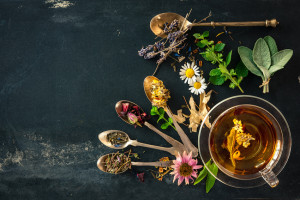
Herbal collage

Enrolling now for the basic herb workshop and herb walks in June!

Come and learn the basics of herbal medicine. We will learn how to identify and use the plants we see, grow and harvest. Even if you have taken this class before you can always join us. There is something to learn for everyone. We will start with an herb walk on Friday June 26th from 9:30 A.M – 12:30 P.M., meeting at the mouth of Lamb’s canyon (exit 137) just off of I-80 up Parley’s canyon. We will spend a few hours identifying and talking about the plants we find. On Saturday morning we will start with another herb walk at my home from 10:00 A.M. – 12:00 P.M. There will be a 1 hour break for lunch (on your own) and then we will meet back at my house for the hands on portion of our class from 1:00 P.M – 4:00 P.M.  We will go over how to make the following herbal medicine that will give you a broad range of uses:

Infusions (herbal tea)
Decoctions – Syrups
Herbal Vinegars – Oxymels
Poultices
Infused Herbal Oils – Herbal Salves
Creams/Lotions
Glycerite/Tincture/Elixir

You will go home with 6 items from the class. (syrup, oxymel, poultice blend, salve, cream, and tincture). Price is $40 including the herb walks and hands on class. There is also an option to just do the herb walks for $20. Class capacity is 20 to maintain social distancing. If you are unable to attend the hands on class you can pick up your kit at your convenience.  No refunds. Deadline to sign up for the workshop is June 20th.  Please sign up through my events page. Feel free to send any questions you may have through my contact page.

rp_Emily-teaching-an-herb-class-300x225.jpg

Women’s Health Herb Walk

vitex

Women’s Health Herb Walk

I will be holding an herb walk on Saturday May 23rd at 10 AM in West Jordan. The cost is $10. We will be focusing on women’s health specifically. Please reach out through my contact page if you are interested in joining us. Spots are limited to maintain social distancing.

Picture is Chaste berry or Vitex agnus-castus


Herbal Women’s Retreat and Herb Walk

rp_springville-canyon-pic-300x225.jpg

I still have room in the retreat for May 28th through the 30th in Spanish Fork UT! The cost is $295. We are still going to go forward with it now that we can be in groups of less than 20. Our group will be small and we would love to add a few more. Please send me a message through my contact page if you are interested.  I will also be holding an herb walk at my home in West Jordan on May 23rd as an extension of the retreat. If you would like to just join is for the herb walk on the 23rd and not the retreat the cost for the herb walk is $10.

Here is our tentative itinerary for the retreat! Hope you can make it!

Thursday May 28th

4:00 pm – Check in

5:00 pm – Let’s get to know each other game!

5:30 pm – Prep for dinner

6:00 pm – 7:00 pm – dinner and clean up

7:00 pm – How to decrease stress in our lives seminar

7:30 pm Gentle yoga stretch and guided meditation

8:30 – Bedtime – free time and swimming until 10 pm. Quiet time after 10 pm. Lights out by midnight we will be hiking the next day.

Friday May 29th

8:00 am – Breakfast and clean up

9:00 am – Herb walk/hiking

12:00 pm – Prep and eat lunch

1:00 pm – 4:00 pm – Hands on herb making class.

4:00 pm – 5:00 pm – Free time

5:30 – Prep for dinner

6:00 pm – 7:00 pm – Dinner and clean up

7:00 pm – 8:00 pm Guest speaker

8:00 pm – Yoga stretch and guided meditation

9:00 pm – 12:00 am Lights out by midnight.

Saturday May 30th

8:00 am – 9:00 am power yoga class

9:00 am – 10:00 am prep, eat and clean up breakfast

10:00 am – 11:00 am – pack up, clean up and check out

Sourdough Buns

Sourdough Buns

These buns are so good! They are perfect for pulled meat sandwiches or burgers and even a side roll with dinner. I love the crumb and flavor with these.

Recipe

1/2 cup starter

2 cups coconut milk

2 tablespoons coconut oil

2 teaspoons sea salt

6 cups white wheat flour or more if needed.

Mix together the starter, coconut milk, oil and salt in a large bowl. You could also use 2 cups water and 1/2 coconut milk powder. Add half the flour and mix well. Add the remaining flour and mix by hand until fully incorporated and the dough is tacky. If the dough is still too wet add a little more flour 1/4 cup at a time. Cover the bowl with plastic wrap and let rise on the counter for 12 to 24 hours.

Once the bread has risen and ready to shape, use avocado or coconut oil to oil the counter. Cut the dough into 14 large round balls about 1/4 cup or so each. Pinch the dough together at the bottom of the roll. You could also make more by making them smaller.

Sourdough Buns 2

Let rise for 1-2 hours until they have doubled in size and are nice a big. Cut the bread to vent and spread the rolls with melted butter. Bake at 375 degrees for 35 minutes.

Caring For Your Natural Yeast Starter

sourdough starter 1

It is amazing to me that I have been able to keep my natural yeast starter alive for years. I learned a few tricks that make it easier and happy to share them with you.  I bought my starter from a friend who bought it from another friend who said it is a strain that is over 200 years old from Czechoslovakia.  Take it for what it’s worth, my experience has been that this is the best mild tasting natural yeast I have ever baked with.

*

First, my starter is fed with organic bread flour. You could use an organic all-purpose flour too. I have tried other grains and it just doesn’t do as well. White flour is best.

*

Second, when adding water to your yeast you must never use chlorinated water. This kills the yeast over time. If all you have is chlorinated tap water let it sit on your counter for 24 hours so the chlorine dissipates.

*

Before each use stir your starter.  If you haven’t used it in a while pour off the liquid (ethanol) and scrape off any gray dough. Stir and use. If it has been a month (or two) between uses consider taking out ½ cup, discard the rest, and feed with 2 cups flour and 2 cups water to renew and boost. (You may need to transfer to a bowl). Leave on the counter overnight, it should bubble up and smell good. From there you can use it. Do not keep your starter in any metal container. Glass or ceramic is best. Before each use it is best to remove it from the fridge and allow to come to room temperature before using.

*

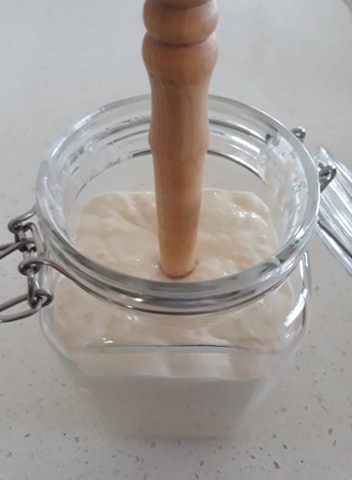
Feed it after each use. Make it thick enough so a stirring stick or spoon can stand on it’s own so it has plenty of food to eat and keep in the fridge. I make 6 loaves of bread at a time when baking for just my family. This takes out 1 and 1/2 cups of the starter from the jar. I usually feed it 1 cup water and 1 and a half cups flour to make it thick. The measurements do not have to be exact. I put plastic wrap over mine because it does need some air to grow unlike other fermented foods. From the picture above you can see that I have removed the rubber liner on my large jar. I allow the lid to sit un-closed on the jar and place in the fridge.

If you need a large amount of starter, place 2 cups starter into a large bowl and feed with 4 cups water and 4 cups flour. Let sit on the counter overnight. If you need more feed again in equal ratios and then use when nice and bubbly and hungry.

*

If you are interested in purchasing some of my sourdough starter in a quart sized Mason jar for $10 send me a message from my contact page. Starters are for sale for pick up only in Utah.

The Healing Art of Herbalism Basic Course for Beginners Videos

Emily teaching an herb class

This past summer I put together 6 basic videos on an introduction to medicinal herbs. With everything that is going on in the world I thought I would share them here on my website hoping it gives others some inspiration to grow an herb garden big or small this year with the extra time many will have at home. Fair warning it was my first time putting together my own videos on you tube. It was a challenge, but I hope you are able to look past imperfections and enjoy the content. Please let me know if you have any questions.

You can find the videos under my media page. https://rootedemily.com/media/

Update! Early Bulk Food and Herb Order

Bulk Food Storage

I moved my bulk food storage order to March 12th. Please have your orders and money in by NOON on that date.  Orders are for pick up only in West Jordan Utah.

List here for items and prices https://rootedemily.com/food-storage/

I also have a new page with bulk herbs and other items with prices https://rootedemily.com/starwest-botanicals-bulk-herbs-spices-tea-blends-extracts-and-more/

This will be the only time we place an olive oil order for the year.

Let me know if you have any questions.

Herbal Remedies & Appropriate Dosing

10-ancient-medicinal-herbal-remedies-that-actually-work

I get questions almost every single day as to how much and what type of herbal remedy a person should take. I refer to this chart often from Rosemary Gladstar with a few minor tweaks and additions that I prefer. I will also describe the different options of herbal remedies you can use successfully with basic directions. The key to successful results with herbs is that you must take them as early as you can, often during the illness duration and after you start feeling better. Hopefully you can find this information as valuable as I have.

Infusions & Decoctions
Chamomile Tea

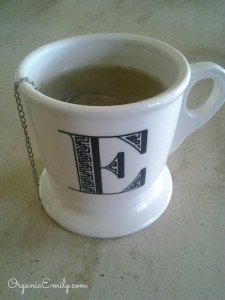
A tea or infusion is made by boiling purified water and pouring it over loose herb, usually leaves and flowers, or herbal tea bags in a cup or even a quart jar. Once the hot water is poured over the herb, cover it so the volatile oils are preserved. Steep for 15 minutes for a mild tea or 30 minutes for a strong tea.  A decoction is made with roots, seeds and barks. These materials usually need a little more heat and time to extract the medicinal qualities into the water. Simmer the plant material on low heat for 20 – 30 minutes with the lid on the pan. Strain and use like an infusion. You can make a quart of tea once a day and drink it throughout the day. When an adult dose is 1 cup…

Age 

Younger than 2 years – ½ – 1 teaspoon

2 – 4 years – 2 teaspoons

4 – 7 years – 1 tablespoon

7 – 11 years – 2 tablespoons

For chronic issues use 3-4 cups daily for 5 days, rest for 2 days, then repeat for several weeks, or until the problem is corrected.

For acute issues use 1/4 – 1/2 cup throughout the day up to 4 cups during illness and a day or two after you start feeling better.

Tinctures & Glycerites
Tincture 6

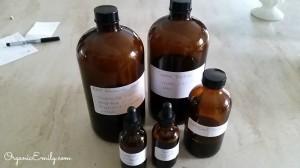
A tincture is made with fresh or dried herbs. I like to use a 1:5 ratio usually. For example if I wanted to make a yarrow tincture I would place 100 grams (you can use ounces too) of dry yarrow herb in a pint jar and 500 milliliters of 50% or 100 proof alcohol. I also like to blend up the herb to create more surface area for better extraction. Cover and shake once a day for 4 weeks. Strain and press out as much of the tincture as you can. I discovered using a potato press works well lined with a coffee filter. Label and date. Tinctures are preferred for their long shelf life and fast acting results. Glycerites are used for little children and babies or those who cannot use any alcohol. I like to use a 1:1 ratio of purified water and organic glycerin. Use the same measurements as the tincture directions. Glycerites must be kept in the fridge and only halve a shelf life of 2-3 years. When an adult dosage is 1 teaspoon (60 drops)…

Age 

Younger than 3 months – 2 drops

3 – 6 months – 3 drops

6 – 9 months – 4 drops

9 – 12 months – 5 drops

12 – 18 months – 7 drops

18 – 24 months – 8 drops

2 – 3 years – 10 drops

3 – 4 years – 12 drops

4 – 6 years – 15 drops

6 – 9 years – 24 drops

9 – 12 years – 30 drops

For chronic issues use 1/2 -1 teaspoon 3 times daily for  5 days, rest for 2 days, then continue for several weeks, or until the problem is corrected.

For acute issues use 1/4 – 1/2 teaspoon every 30-60 minutes during an illness and for another day or two after you start feeling better.

Syrups & Oxymels
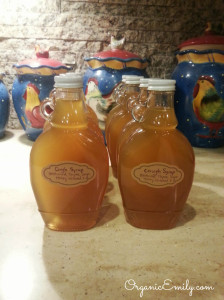
Sage, thyme and Horehound Cough Syrup

Syrups are made by making an infusion or decoction of your choice of herbs and then strained into a large measuring cup. Add equal amounts of honey or glycerin and half part brandy if you like to extend the shelf life. Keep in the fridge for up to 6 months. Oxymels are very similar, except you would macerate or soak herbs in warm apple cider vinegar for 4 weeks like a tincture. Then strain and add equal amounts of honey. Also keep oxymels in the fridge for up to 6 months. When 2 tablespoons is an adult dose…

Age                                                                                                                                        

Younger than 2 years – 1/4 – 1 teaspoon

2 – 4 years – 1 teaspoon

4 – 7 years – 2 teaspoons

7 – 11 years – 1 tablespoon

For chronic issues use 1 – 2 tablespoon 3 times daily for 5 days, rest for 2 days, then continue for several weeks, or the problem is corrected.

For acute issues use 1 teaspoon every 30-60 minutes during an illness and for another day or two after you start feeling better.

Capsules or  Tablets 

When an adult dose is 4 capsules. Cut in half for children under 12 that can swallow a capsule.

For chronic issues take 4 caps 2x a day for 5 days, rest for 2 days, then continue for several weeks until symptoms subside.

For acute issues take 4 caps 3 -4 times a day for a few days after you start to feel better.

Herbs For Respiratory Illness and Cytokine Storms

Image:

No one likes to be sick that is for sure! As a mom of 7 kids we are proactive about our health by eating wholesome food, drinking purified water, getting adequate sleep, staying active and getting plenty of sunshine. During the winter months that can be a little more difficult to do so we take vitamin D3 with K2 for better absorption. My little ones get gummies from Nordic Naturals. Cod liver oil is a great option for vitamin D and is a whole food source which many feel is more superior. Whole food vitamin C is an important part of our daily routine. When someone gets sick in the family they switch to sodium ascorbate. It moves into the cells faster and is less expensive. This is just what we do and by no means should this information be taken as medical advice. This post is for educational purposes only.

There has been a lot of information being shared about the Coronavirus on social media and news outlets.  We know that the numbers are growing around the world, including within the United States.  Health officials have reported that the US is preparing for a pandemic to come here. See this report here

I do not share this information to create panic or fear, on the contrary, I would like to share with you what I understand about the virus, what is happening to the people that aren’t recovering from it and how we can stay healthy and overcome it within our own families.

We know the virus is spreading by human to human transmission, by contact of bodily fluids and aerosol means, meaning through the air.  People who have contracted the virus have experienced fever, sneezing, cough, even stomach cramps, headaches and confusion, but not everyone experiences the same symptoms. For more information see this article

I really liked this report from American Thought Leaders. I highly recommend watching the video to be able to understand the full picture. Laurie Garrett is a reporter who travels around the world to learn about epidemics including, MERS, SARS and Ebola. She discusses simple precautions on how to keep you and your family safe along with what is actually happening in China.  Laurie also mentions something that happens to the people that are dying. These people are experiencing many of the same symptoms as this 56 year old woman has been experiencing. The report states, “She was still on oxygen support when the doctor told her she was ready to go home. She couldn’t stop coughing. Too much fluid was filling up her lungs because of the viral infection, causing chest pains and making it hard for her to breathe” article (Chinese economy is suffering so people are being forced to go back to work even while they are sick).

Time and time again I keep reading and hearing about what I know to be cytokine storms. Cytokines are important chemical signals produced by the immune system to activate other pathogen fighting cells. These immune cells react to the increased cytokine levels by moving toward the infection site and releasing more cytokines. This creates mucus that traps the pathogens and gets rid of them through mucus production, sneezing, coughing and so on. The problem occurs when, after 5-7 days of being ill, one starts to feel worse and not better. The woman mentioned in the article above says that she felt like fluid was filling her lungs making it difficult for her to breathe.  That is a cytokine storm. This is the reason why people died during the Spanish Influenza of 1918 where it was estimated that 100 million people died around the world. Cytokine storms can also turn into pneumonia causing death in high risk people. We know that all viruses act in different ways and are still trying to figure this one out.

There are some great herbs that can increase cytokines at the beginning of an illness. Remember cytokines aren’t bad, they are important to help move pathogens out of the body and should be used at the beginning of an infection.  There are many herbalists that have differing views on which herbs increase cytokines. Some that have been listed include, elder, echinacea, ginsengs and even chocolate and honey.  These herbs and foods are good to take at the beginning of an illness, including the coronavirus. In fact they are my first choice, especially elder. If however a person starts to feel worse a week or so into the infection it would be wise to stop taking the cytokine stimulating herbs and start taking herbs that decrease cytokines. Those herbs include Turmeric, Garlic, Ginger, Grape leaves, St. John’s Wort, Milk thislte, Scullcap, Yarrow and Yerba mansa.

Another important aspect is that we need to keep the detox pathways open when we are sick. This includes the colon, liver, kidneys and lymphatic system. Yerba mansa helps with lymphatic flow as well as calendula, echinacea and cleavers. Taking adequate amounts of magnesium and pysillium husk powder will help the colon to continue to move. Milk thistle, dandelion root, yellow dock root and burdock root are all great for keeping the bile flowing through the liver. Epsom salt baths are also good for keeping the liver pathways open. Drinking plenty of purified water is important for kidney function. Dandelion leaf, chamomile and cleavers are great herbs for the kidneys.

Other herbs that were used during the Spanish Influenza by many Native Americans were Lomatium and Osha. These are very powerful antiviral plants that can be taken throughout the duration of an illness. Angelica root was used during the black plague in Europe and is known to be a very good circulatory herb to keep things moving through the body.

The herbs mentioned above can be taken as a tincture or a tea for best results as single herbs or as formulas. Listed below are 21 respiratory herbs that can help with different symptoms. Please reach out if you have any questions. There are so many other herbs that I could mention, but these are easy to grow and find. Stay healthy and think about building up your basic needs in case there comes a time to quarantine where you live.

Lobelia

Lobelia inflata, a fabulous antispasmodic herb that can help to relax constricting smooth muscles. Good for opening the airway. This herb is not recommended during pregnancy.

Hyssop

Hyssopsus officinalis, or Hyssop is a wonderful expectorant with a long history dating back to biblical times. This herb should be avoided during pregnancy.

Horseradish

Armoracia rusticana or Horseradish is a great herb for clearing the sinuses and killing pathogens, clearing the lungs as a good expectorant. Do not take in large amounts as it can create GI upset.

Fir

Fir or Pine needles are fabulous antimicrobial plants. They are also good expectorants and very high in vitamin C. There are no known warnings.

Elecampane

Inula helenium or Elecampane  is probably one of the best expectorant herbs there are. There are no known warnings.

Brigham tea 1

Brigham tea and other Ephedra spp. (the picture above is called green joint stem) are very good bronchial dilators that can help open the airway. There are no known warnings for Brigham tea.

chooke cherry shrub

Prunus virginiana or Wild Cherry bark comes from the choke cherry tree/shrub. It is excellent for calming dry hacking coughs and has gentle expectorant properties. Not recommended for long periods of time or during pregnancy.

Thyme plant

Thymus vulgaris or Thyme is a good antimicrobial and expectorant. There are no known warnings. Just avoid in large doses during pregnancy. Normal doses are fine.

rp_Gumweed-1-165x300.jpg

Grindelia spp. also known as Gumweed is an excellent expectorant, antispasmodic and antibiotic making this a great herb for bronchial infections and asthma. Do not take in large doses or for long periods of time by those who suffer from kidney or heart disease.

rp_Cayenne-166x300.jpg

Capsicum annum or Cayenne is a fabulous herb for breaking up mucus within the respiratory system. It is also great at killing off pathogens. Start with small doses and build up tolerance.

rp_Garlic-plant-165x300.jpg

Allium sativa or Garlic is a good antimicrobial and on our list for decreasing cytokines. Best to take with food so it doesn’t cause upset GI issues.

Echinacea plant

Echinacea purpurea is a great immune stimulating herb that is also good for moving the lymphatic system. This herb increases cytokines. Use with caution is you have an autoimmune disorder otherwise it is perfectly safe for all.

rp_peppermint-plant-300x165.jpg

Mentha piperita or Peppermint is a great antimicrobial herb and is good for relieving headaches and breaking fevers. Can increase heartburn and GI upset with certain people.

Yarrow 3

Achellia millifolium or Yarrow is great known for it’s antibiotic properties as well as a diaphoretic herb that can help with breaking a fever through sweating. This one will also help to decrease cytokines and is great for using throughout an infection period. Not intended for use during pregnancy. Generally safe but not intended to be used for ling periods of time.

rp_St.-Johns-Wort-plant-166x300.jpg

Hypericum perforatum or St. John’s Wort is a good antiviral herb and also good for nerve pain.  This herb will not increase cytokines. Not intended to be taken during pregnancy or with other SSRI anti-depressant prescription drugs.

Marshmallow plant

Althea officinalis or Marshmallow is really soothing to inflamed tissues and can help coat and protect tissue in the lungs like cilia from too much coughing. No known warnings. Very safe for all ages and conditions.

Blackberry

Rubus spp. Blackberries and Raspberries (leaves and roots) are great astringent herbs for diarrhea. No known warnings.

rp_mullein-1-166x300.jpg

Verbascum thapsus or Mullein is calming to the nerves in the respiratory system to help with a constant cough. It is also a good expectorant. The flowers are good for pain especially pain caused by ear aches. Leaves, flowers and roots are safe. Seeds are toxic.

Comfrey

Symphytum officinalis or Comfrey is a great expectorant and can help heal damaged tissue. Generally safe herb. Not intended for use during pregnancy or for those on a lot of prescription drugs.

rp_Plantain-1-166x300.jpg

Plantago spp. or Plantain is a good expectorant and vulnerary herb to help heal damaged tissue. It is also used against sepsis. No known warnings.

Elderberries on Plant

Sambucus nigra or Elderberry is one of the strongest antiviral herbs there are for influenza and other respiratory infections. The flower is good for clearing pressure in the Eustachian tubes, and a good diaphoretic. The berry is a good expectorant as well.  Use only the dried herb as the fresh can be mildly toxic.


Cold Remedy Chicken Soup

Immune Boost Chicken Vegetable Soup

I love this soup! I love the process of it too! From cooking the whole chicken for a few hours during the day with organic vegetables and herbs to actually making the soup itself. This soup is nutritionally dense, supports the immune system and digestion. We love to eat it with homemade sourdough bread!

Recipe

For the Chicken and Broth

1 whole organic chicken

10 cups purified water like Reverse Osmosis

1 tablespoon sea salt

1 teaspoon peppercorns

1 onion, quartered

2 ribs celery

2 carrots

1 leek

1 small 3×5 or 4×6 muslin bag or mesh tea ball filled with 1 tablespoon each of all or your choice burdock root, dandelion root, milk thistle seeds, astragalus root, echinacea root. (you could even throw in the herbs and then strain. I like to put them in a bag because I throw it into the soup for a second decoction).

86229725_214905889664525_1804229844523810816_n

Cook the whole chicken with the salt, peppercorns, veggies and herbs on medium heat simmering for a few hours until the chicken meat is tender and falls off the bone. Strain into a bowl and shred the chicken. Set the chicken aside and measure out 8 cups of broth. Set aside.

For the Chicken Soup

2 tablespoons avocado oil

1 small onion chopped

1 head garlic chopped (set half aside)

2 tablespoons ginger finely chopped

1 teaspoon sea salt

1/2 teaspoon fresh ground black pepper

1 large celery root chopped (or parsnips or even potatoes if you want)

6 large carrots chopped

4 celery stalks chopped

1 bunch flat leaf parsley chopped

On medium heat add the avocado oil to a large dutch oven pot. Saute the onion, half the garlic, ginger, salt and pepper for a few minutes. Add the carrots, celery, celery root and saute for a few more minutes. Add the broth and the muslin bag of herbs again. Simmer on medium until the vegetables are tender. Remove the bag of herbs and add the chicken and chopped parsley. Check to see if the soup needs more salt. Serve warm.