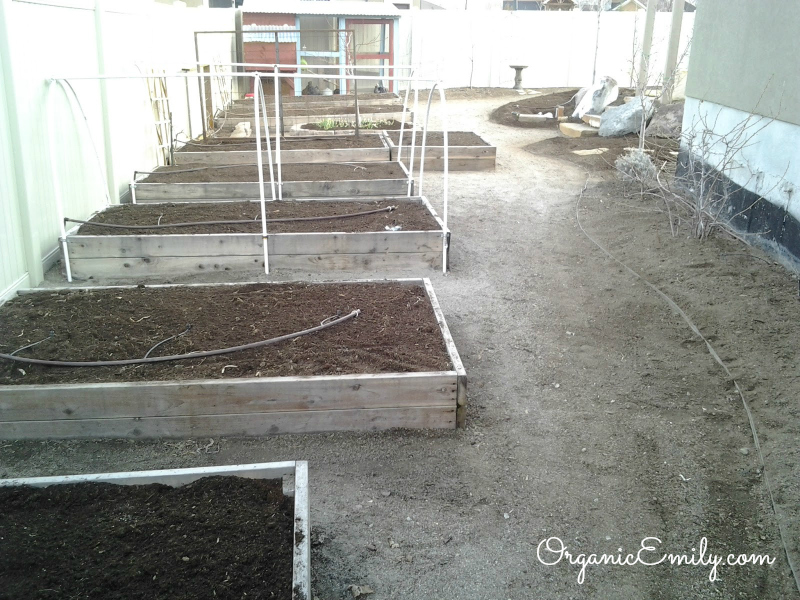
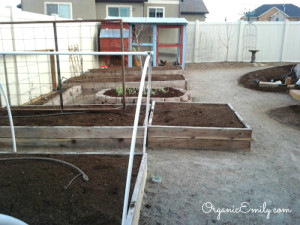
 Spring clean up can be so much fun especially after being cooped up inside all winter! It takes me about a full week to prune, clean the beds of any debris/leaves and lay down compost. Above is a photo of the “bones” of my garden. You can see my chicken coop in the background and a few vertical structures for vine crops to grow up. In front is a hoop house frame I use to grow cold crops in the fall and preserve throughout the winter. I grow most of my veggies in garden boxes.
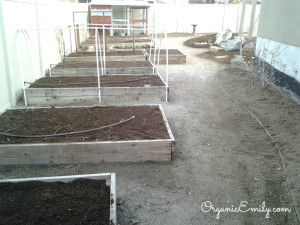 Here are all 8 grow boxes on the east side of the house. This entire area gets at least 8 hours of sunlight in the summer, except for the bed right up against the house. There I get about 6-7 hours and grow currants and elderberries ( you can also grow leafy veggies in 6 hours of sunlight too). It is very important to create a plan before just throwing down soil, boxes and plants. Think about how much sunlight the plants will need (at least 8 hours for most), and if it is functional and easily accessible. For example, be sure to allow a wide walk way for a large wheelbarrow to bring in good organic compost every year.
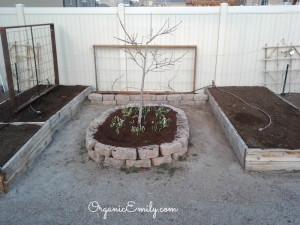 My Early Elberta peach tree with scallions planted all around to help deter peach borers (any allium family member should help). Another great way to deter pests, including borers is to cultivate the soil every 2 weeks, 2-3 feet from the trunk out and about 2-3 inches deep. This will interrupt the life cycle and kill off eggs and larva. It has been pruned as an open center tree to allow sun light into it to ripen the fruit. In the background is another vertical stand for my grapes to grow up and out.
This week I have been busy getting the soil ready to plant my cold crops tomorrow! The weather has been fabulous! Whether you grow your produce in garden boxes or in the ground you need to make sure the soil is workable. A simple test to see if it has dried out enough is to take a handful and squeeze it, if it retains the shape of your hand mark then it may still be too wet. You can also drop the handful to the ground, if it stays in a clump it isn’t ready. If it falls apart you are good to go! Any raised bed method is going to dry out much quicker than just straight from the ground. If you want to speed up the process of heating up the soil, put down some clear plastic, anchored with rocks for about a week. This will heat up the soil and dry it out faster for planting earlier.
As far as soil preparation goes I bring in good organic compost every year, like Nuri-mulch or Furti-mulch. I dump wheelbarrow loads into every garden box along with a good, dry, ORGANIC, low number fertilizer (usually containing beneficial bacteria and mycorrhizae (beneficial fungus)). The low numbers in the fertilizer won’t burn the seeds and give the plants the healthy head start they need. I do not use chemical fertilizers for the reason they kill many micro-organisms that actually help protect and keep the plants healthy from disease and pests. Besides who wants to eat chemicals anyways? I don’t till my soil. I use a vertical till process that is gentle on those precious micro-organisms. Take a shovel or garden spade (large fork) and gently turn the soil. Smooth out with a rake. It’s as simple as that! I also recommend watching a wonderful documentary called “Back to Eden” found online www.backtoedenfilm.com it is a no till method all together. The weather is perfect this week in Utah! Get out there and plant something new! Happy gardening!

 Spring is in the air and those cold hardy herbs like mint and parsley are waking up from their winter’s sleep! This salad pulls those herbs from the garden to your table and is so delicious and satisfying! I love the sweetness from the cucumber and mint and the tang from the tomatoes and lemon! Great for lunch or a side for entertaining!